Instant Pot Pro 2026 Review: Real-World Results
By Mei Tanaka • 19th Mar
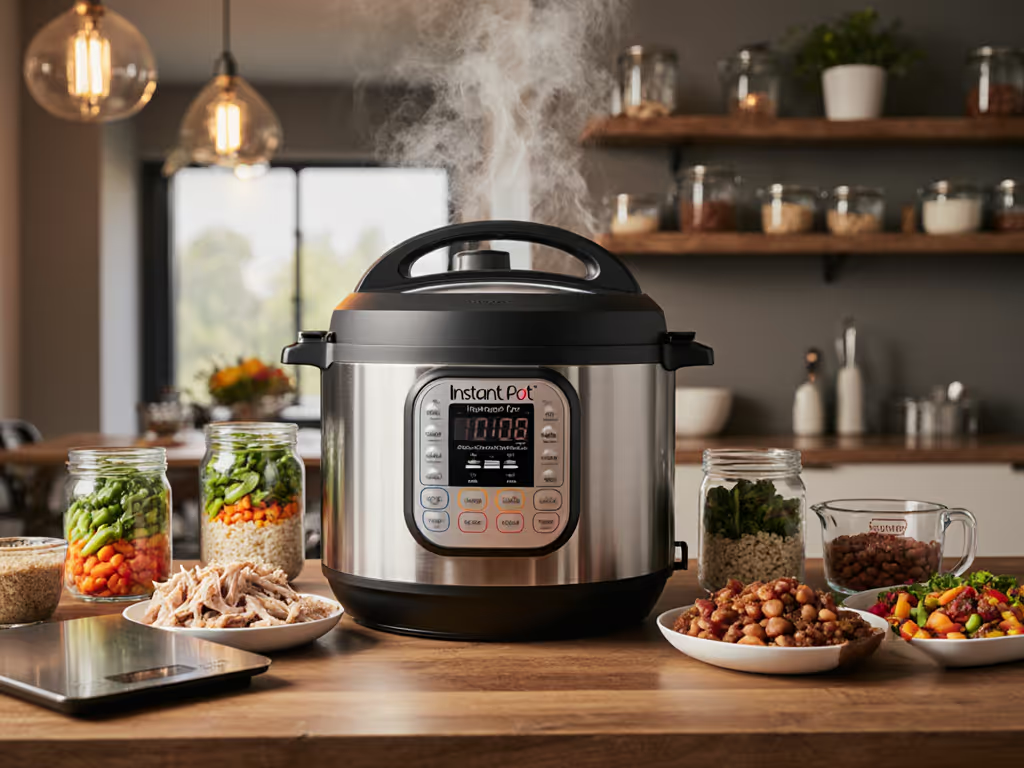
The Instant Pot Pro 2026 review matters most to home cooks tired of guessing whether a pressure cooker will actually save time or add complexity to their week. A premium pressure cooker in 2026 sits at a crossroads: it promises reliability, capacity, and speed, but only if it fits your actual workflow. This article cuts through the noise with real timings, yield data, and practical templates that turn pressure cooking from a mystery into a predictable system.
Why Capacity and Control Matter More Than Features Alone
When I first optimized my meal-prep system, I learned that most home cooks chase features they'll never use. What they actually need is smart pressure cooking technology paired with large-batch capacity and transparent cooking data. The Instant Pot Pro, available in both 6-quart and 8-quart sizes, solves a real problem: it eliminates the gap between "enough food for tonight" and "enough food to freeze for Tuesday."[1][2]
The Instant Pot Pro multi-use pressure cooker 8 qt offers 10 cooking functions, including pressure cook, slow cook, sous vide, sauté, sterilize, yogurt, rice, bake, steam, and keep warm.[1] This isn't feature bloat if you use batch cooking workflows. A single 8-quart session of beans, broth, or braise yields enough portions to freeze across multiple meals, but only if the cooker heats reliably and releases pressure consistently. For precise times and no-soak methods, see our pressure cooker bean guide.
Here's what separates the Pro from cheaper models: it has 1,200 watts of power, enabling a preheat time that's 20% faster than standard units and reducing overall cook time by up to 70% compared to stovetop methods.[2][4] For meal-preppers, that difference compounds. A faster preheat means predictable total time. A 70% reduction in active cooking means you reclaim weeknight hours.
Templates over guesswork, and that principle holds whether you're cooking one meal or five.
Pressure Settings and Release Methods: The Data You Actually Need
Most high-end pressure cooker comparison reviews gloss over the practical differences in pressure release and venting methods. If you're unsure when to choose natural vs quick release, use our natural vs quick release guide. That's where user frustration lives. The Instant Pot Pro includes three pressure settings (high, low, and max), plus a pulse setting for steam release that reduces splatter.[3] For batch cooking, this precision matters.
Here's a real-world timebox for common batch proteins and legumes using the Instant Pot Pro:
Cook Times with Pressure Settings and Release Methods
Proteins (High Pressure)
- Beef, large chunks (1 lb per portion): 25-30 min cook + natural release (~10 min). Minimum liquid for 6QT: 1.5 cups; 8QT: 2 cups.[1]
- Chicken breast, boneless (1 lb per portion): 5-8 min cook + natural release (~8 min). Minimum liquid for 6QT: 1.5 cups; 8QT: 2 cups.[1]
- Whole chicken (1 lb per portion): 8 min cook + natural release (~10 min). Total meal-prep time: ~20 min active, 18 min passive.[1]
- Pork butt roast (1 lb per portion): 15 min cook + natural release (~12 min). Yields tender shreds for freezer storage. Minimum liquid for 6QT: 1.5 cups; 8QT: 2 cups.[1]
- Pork back ribs (1 lb per portion): 15-20 min cook + natural release (~12 min).[1]
- Lamb leg (1 lb per portion): 15 min cook + natural release (~10 min). Minimum liquid for 6QT: 1.5 cups; 8QT: 2 cups.[1]
Legumes and Grains (High Pressure)
- Dried beans (unsoaked): 17 min cook + quick release. Yields ~8 cups per 2 cups dry beans.[1]
- Green or brown lentils: 8 min cook + quick release. No presoak needed. Yields ~6 cups per 2 cups dry.[1]
- Pinto beans (soaked): Cook time varies; consult manual for soaked legume charts.[1]
Why does this matter? Because when you scale from a 3-quart to a 6-quart or 8-quart pot, liquid minimums don't scale linearly, and cook times don't always adjust. The Pro's larger capacity lets you batch-cook 2-3 times a week instead of daily, but only if you understand exactly how much liquid each pot size requires and how pressure and venting affect final texture.
Temperature Control and Sous Vide: Precision for Specific Workflows
The Instant Pot Pro includes precise temperature control for sous vide cooking, a function absent in cheaper models.[4] For batch cooks managing texture-sensitive proteins (chicken breast, salmon), this matters. Sous vide at exact temperature ensures uniform doneness across portions, which simplifies reheating and freezer storage notes.
However, and this is critical, sous vide adds prep complexity if your goal is speed. It requires sealed bags, longer cook times (typically 45 min to 2 hours), and a cooling step. Use it only if your workflow has a specific need (managing precise moisture retention, batch-cooking delicate fish). For stews, braises, and tender shreds, traditional high-pressure cooking is faster and simpler.
Bake and Neutral Boost: When Extra Features Earn Their Weight
The Pro's bake setting enables bread and cake baking in-pot, a feature the Instant Pot Plus lacks.[3] For meal-preppers in small kitchens with limited oven access, this is genuinely useful. Batch-baking four small loaves on a Sunday eliminates weekday bread decisions.
The Neutral Boost setting uses gentle pulses during cooking to create deeper flavor development. It's a subtle advantage over steady high-pressure cooking, but in batch workflows where you're preparing the same braise or stew twice monthly, that flavor consistency compounds across meals.
Capacity Math: 6-Quart vs. 8-Quart for Real Meal Prep
The 6-quart model accommodates six servings per meal [2]; the 8-quart extends that to eight or, in smaller-portion scenarios, enables 10-12 freezer portions of beans or shredded meat. Here's the practical math:
6-Quart Yield: Batch of Braised Chicken Thighs + Rice
- 2 lbs chicken thighs (4 portions, pre-cooked): ~3 cups
- 1 cup rice + 1.5 cups liquid + aromatics: ~4 cups total
- Safe fill line (two-thirds capacity): 6 quarts × 2/3 = 4 quarts used
- Freezer yield: 4 portions over 2-3 weeks
8-Quart Yield: Same Recipe, Scaled
- 3 lbs chicken thighs (6 portions): ~4.5 cups
- 1.5 cups rice + 2.25 cups liquid + aromatics: ~6 cups total
- Safe fill line (two-thirds capacity): 8 quarts × 2/3 = 5.3 quarts used
- Freezer yield: 6 portions over 2-3 weeks
For dual-income households or families prepping lunch components, the 8-quart is the better choice. For couples or singles batch-cooking three times monthly, 6-quart suffices. Both models have dishwasher-safe inner pots and lids, a non-negotiable for anyone tired of hand-scrubbing pressure-cooker parts.[2]
Safety Features and User-Facing Workflows
The Instant Pot Pro includes overheat protection, auto-sealing safety lid lock, and easy-grip handles on the inner pot, small details that prevent accidents in busy kitchens.[1] The auto steam release is fully automatic; you don't manually control a valve like on Plus models.[3] For households with kids or less familiar cooks, this reduces error.
However, automatic steam release is only one part of safety. You still need a protocol:
- Pre-cook check: Verify silicone sealing ring is seated; check for visible damage.
- Liquid minimum: Measure and add per the pot-size chart above. Never skip this step.
- Pressure setting: Select high or low; max pressure is available but rarely necessary for standard recipes.
- Venting method: Choose natural release (lid stays sealed; pressure releases slowly over time) or quick release (manual valve opening). Natural release suits tougher cuts and legumes; quick release suits delicate vegetables and grains.
- Post-cook: Once pressure drops (pressure indicator drops fully), carefully open lid away from face. Use natural light to check doneness; don't rely on color alone.
28 One-Touch Programs: Template-Driven Simplicity
The Pro's 28 customizable smart programs sound like overkill until you see how they simplify weeknight cooking. These are pre-loaded templates for common recipes: beans, rice, soups, stews, yogurt, sterilizing jars.[1] For meal-preppers, the value is repeating the same program at the same time each week, removing decision-making.
Monday prep day example:
- 7:00 AM: Start Program 5 (beans) with 2 cups dry beans + water.
- 8:15 AM: While beans cook, assemble proteins for Program 3 (braise).
- 8:45 AM: Beans finished; transfer to containers, label with date and yield.
- 9:00 AM: Start Program 3 (braise).
- 11:15 AM: Braise finished; cool, portion, and freeze.
- Total active time: ~30 minutes. Passive time (cooking and cooling): ~2 hours.
This is the inverse of the chaos I used to experience on Sunday nights, the old method was recipe hunting, guessing cook times, and hoping nothing scorched. Templates turn pressure into predictable, calm weeknights and full fridges.
Energy Efficiency and Total Time to Eat
Pressure cooking reduces cook time by 70% compared to conventional methods; whole chicken cooks in ~8 minutes at pressure versus ~90 minutes in an oven.[1][3] Learn the science behind these energy savings in our pressure cooker energy guide. But total time to eat includes preheat (~5-7 min for the Pro due to its 1,200-watt heater) and natural release (~8-15 min depending on recipe). So a "30-minute" chicken meal is really 30 min pressure + 12 min preheat/release = 42 min total.
Understanding this is crucial for meal planning. Pressure cooking saves energy versus extended oven time, but it doesn't eliminate prep or downtime. Use that downtime intentionally: prep tomorrow's vegetables, set up freezer labels, or plan the next week's proteins.
Comparison: Instant Pot Pro vs. Instant Pot Plus
Both models share 12 PSI maximum pressure and BPA/PFOA/PTFE-free construction with silicone-coated handles.[3] The Pro distinguishes itself with:
- Bake and Neutral Boost settings (Plus lacks these)
- Automatic steam release (Plus requires manual valve control)
- Three pressure levels (high, low, max) plus pulse release vs. Plus's two levels
- Seven sauté temperature options vs. Plus's five
- Quieter, certified steam release vs. Plus's standard venting
For casual cooks, the Plus is sufficient. For batch cooks who value consistency and faster preheat, the Pro's extra $100-$150 investment recoups through reduced weeknight stress and fewer failed batches.
Practical Freezer-Ready Workflows
The Instant Pot Pro's 8-quart size is ideal for freezer-first meal prep:
Template: Monday Batch Session (8-Quart Pro)
Step 1: Prep (10 min)
- Arrange 3 lbs protein (chicken thighs, beef chuck, pork shoulder), 1.5 cups aromatics (onion, garlic, herbs), 1 cup liquid (broth or wine), vegetables (carrots, potatoes).
- Batch note: "Braise, 6 portions, high pressure, natural release."
Step 2: Pressure Cook (15-25 min at pressure + 10 min preheat)
- Select braise program or manual high pressure.
- Estimated total: 50 minutes.
Step 3: Cool and Portion (20 min)
- Natural release completely; transfer to containers.
- Label with protein, date, yield ("Beef braise, 3/19/26, 6 portions"), and reheat note ("Thaw overnight or reheat on stove 350°F/15 min").
- Freeze.
Step 4: Repeat (2 PM)
- While braise cools, prep beans for Program 5: 2 cups dry beans, 6 cups water, salt.
- Total cook + release: 30 minutes.
- Cool, portion (yield: 8 cups or ~4 side portions × 2 weeks), label, freeze.
Step 5: Reset (3:30 PM)
- Clean inner pot and sealing ring.
- Optional: Broth for week's soups (4 cups carrots/celery/herbs + 6 cups water, 30 min high pressure).
Total time invested: ~3.5 hours active + passive. Freezer yield: 18 prepared portions or component staples across three batches.
This is the system that replaced chaos. It's not glamorous, but it survives Tuesday fatigue.
Maintenance and Long-Term Reliability
The Instant Pot Pro's silicone sealing ring retains odor and should be replaced every 12-18 months of regular use. Follow our pressure cooker maintenance guide for step-by-step cleaning and care to extend lifespan. The dishwasher-safe inner pot and lid simplify cleaning and extend appliance life. The 1,200-watt heating element and stainless steel construction align with Mei's bias toward large-capacity, durable gear suited to weekly batch cycling.
Expect to spend $30-$50 annually on gasket replacement and occasional spare parts. That cost is negligible against the value of consistent, safe batch cooking.
Final Verdict: Is the Instant Pot Pro 2026 Worth the Investment?
The Instant Pot Pro 2026 is the right choice if:
- You batch-cook twice weekly or more and freeze portions
- You need predictable cook times and 28 pre-loaded templates to eliminate guesswork
- You value safety features (auto steam release, overheat protection) and dishwasher-safe parts over trendy gadgets
- You're willing to invest $350-$400 upfront to reclaim 5-8 hours monthly on meal prep simplicity
- Your kitchen is small; the 8-quart size replaces multiple appliances (pressure cooker, slow cooker, sous vide circulator)
- You cook for a family, duo, or yourself but freeze generously
Skip it if:
- You cook single meals nightly and never freeze ahead
- Your kitchen has room for specialized gear (oven, slow cooker, stovetop)
- You're resistant to learning pressure-cooking fundamentals (liquid ratios, release methods, venting protocols)
- Budget constraints favor the Instant Pot Plus or Lux models, which handle basic recipes reliably
The Real Gain
The Instant Pot Pro's true advantage is not speed alone, it's consistency. With transparent cook times, clear liquid minimums, 28 one-touch templates, and proven reliability, it transforms pressure cooking from a risky experiment into a repeatable system. Batch a month of proteins, grains, and broths once weekly; freeze with dated labels; reheat with confidence. The cost per prepared meal drops, food safety improves, and tired weeknights taste like a plan.
That's what matters in 2026: not more features, but systems that work. Templates over guesswork. Predictable pressure, predictable peace of mind.
Related Articles